THE SYSTEM
Effective collaboration requires power you can name.
Collaboration Doesn't Fail From Lack of Goodwill
It fails when essential forms of power remain invisible. Without language to recognize different ways of contributing—observing vs acting, stabilizing vs disrupting, focusing vs contextualizing—groups cannot navigate the tensions that make coordination possible.
What you cannot name, you cannot navigate.
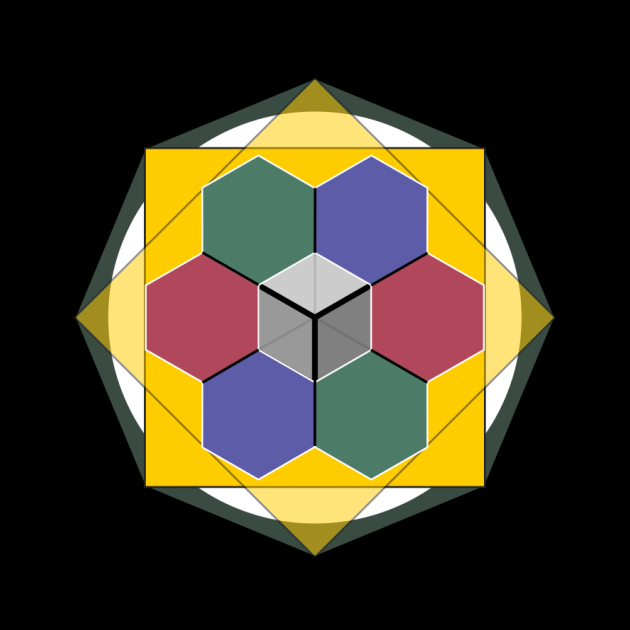
The System provides that language. Three orthogonal axes map how organized systems maintain themselves through tension. Eight archetypal positions emerge from their combination. Not personality types to identify with, but functional requirements every healthy system needs.
Why This Matters Now
When collaborative systems make everyone feel powerless—trapped in endless discussion, unable to act, watching problems worsen—people turn to authoritarianism. Not because hierarchy works better, but because powerless collaboration becomes unbearable.
The gap between our collaborative intentions and our capacity to deliver is widening.
We face planetary-scale challenges—climate, migration, coordination across vast difference—that require unprecedented forms of collective intelligence. Yet our institutions still operate with industrial-era models: central control, analytical dominance, visible action as the only valued contribution.
Meanwhile, essential capacities atrophy: holding paradox, sensing emergence, valuing the relational work that makes sustainable action possible.
We need frameworks that make power explicit, legitimate, and navigable.
How The System Works
Three Universal Tensions
Every organized system balances three orthogonal dimensions:
ENERGY DIRECTION
Act ↔ Observe
- Do we produce external outputs or build internal capacity?
- Create visible change or strengthen relationships?
APPROACH TO CHANGE
Disrupt ↔ Stabilize
- Do we test new approaches or deepen existing practices?
- Experiment with alternatives or refine what works?
ATTENTION PATTERN
Focus ↔ Zoom Out
- Do we work toward defined outcomes or sense systemic context?
- Deliver concrete results or track emerging patterns?
These aren't choices you make once. They're tensions you navigate constantly. Healthy systems need access to all positions. Not agreement, but functional diversity.
The Eight Orientations
When any orientation is missing, the system becomes predictably dysfunctional:
- Networks without Stabilizers generate brilliant ideas but complete nothing
- Teams without Observers exhaust themselves producing outputs no one needs
- Organizations without Focus talk endlessly without decisions
- Movements without Disruptors calcify into the very structures they opposed
The System makes these gaps visible before they become crises.
Diagnostic Practice
Mapping Your Network
This site provides systemic diagnostics for collaborative networks:
- Define your boundary
What specific collaborative context are you examining? - Survey participants
Three behavioral questions identify actual orientations - See the whole system
Distribution reveals strengths and critical gaps - Intervene structurally
Address missing functions through design, not recruitment alone
The goal isn't balance for its own sake. It's recognizing which tensions are suppressed and what that costs you.
Active Networks
Current Mappings:
Time to Listen
The Time to Listen Network is a global community of music professionals dedicated to exploring the intersection of music and sustainability.
Time to Listen Participants
The Time to Listen Network is a global community of music professionals dedicated to exploring the intersection of music and sustainability.
Demo Network (Open Registration)
Test network with open registration - anyone can submit with password
Theoretical Foundation
Grounded in Systems Theory, Validated by Practice
The System synthesizes:
- I-Ching trigram logic (3 binary dimensions = 8 complete positions)
- Viable System Model (Beer) - requisite variety for navigation
- Polarity Management (Johnson) - tensions to manage, not problems to solve
- Triadic Topology Theory (T3) - mathematical necessity of three axes
Tested across:
- Distributed creative networks
- Housing cooperatives and mutual aid groups
- Platform engineering teams
- Social movement organizing
The framework is agent-agnostic—it applies to human-human, human-AI, and AI-AI coordination. As we develop post-human collaborative infrastructure, these tensions remain fundamental.
Get Started
Map Your Network
Request access to create a diagnostic survey for your collaborative network